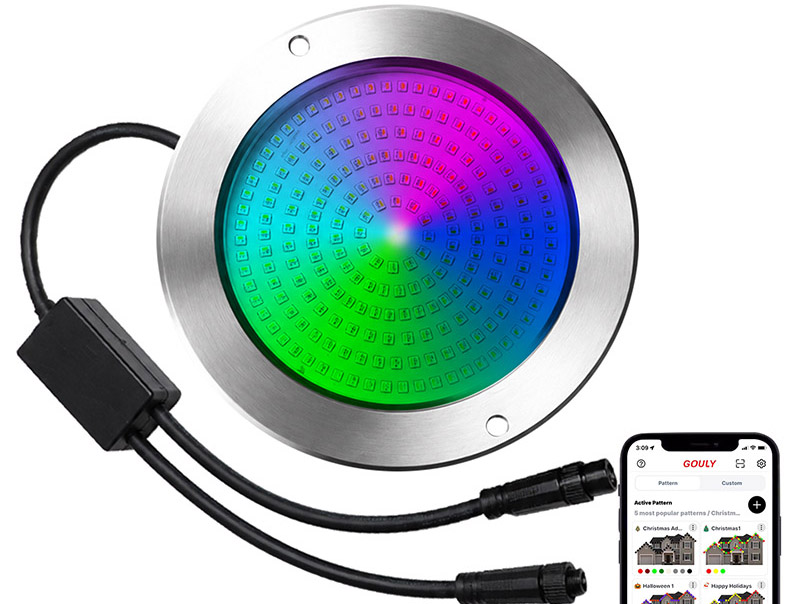
RGB and RGBW permanent outdoor lights can both produce colorful effects for holidays, events and architectural accents. The main difference is how they produce white light.
RGB fixtures create white by combining red, green and blue light. RGBW fixtures add a dedicated white-light channel, allowing the same system to produce colorful effects and cleaner white architectural lighting.
For installations used mainly for holidays, RGB may be sufficient. For year-round residential and commercial lighting, RGBW is generally the more versatile choice.

What Are RGB Permanent Outdoor Lights?
RGB stands for red, green and blue. By adjusting the output of these three channels, an RGB lighting system can create a wide range of colors and animated effects.
RGB permanent outdoor lights are commonly used for:
- Christmas and holiday displays
- Halloween lighting
- Sporting events
- Parties and celebrations
- Color-changing rooflines
- Commercial entertainment spaces
When all three channels operate together, RGB lights can simulate white. However, the resulting light may have a slightly cool, blue or uneven appearance depending on the LEDs, controller calibration and fixture design.
RGB is most suitable when decorative colors are more important than natural everyday white illumination.
What Are RGBW Permanent Outdoor Lights?
RGBW fixtures include red, green, blue and a dedicated white channel. The white emitter may be integrated into the same LED package or installed separately within the fixture.
Depending on the product, the white channel may be available in:
- Warm white, typically around 2700K–3000K
- Neutral white, typically around 3500K–4000K
- Cool white, typically around 5000K–6500K
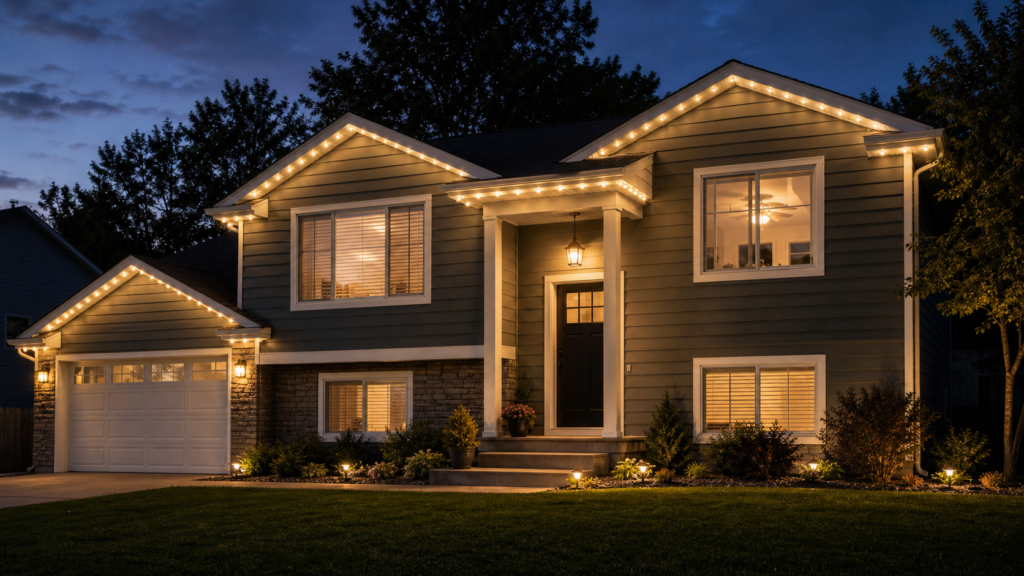
The dedicated white channel gives RGBW systems a significant advantage for everyday architectural lighting. Property owners can use warm white lighting during normal evenings and switch to colorful patterns for holidays or special events.
Always confirm the actual color temperature and LED configuration on the product specification sheet.
RGB vs RGBW Permanent Outdoor Lights
| Feature | RGB | RGBW |
|---|---|---|
| Color channels | Red, green and blue | Red, green, blue and white |
| White-light production | Mixed from RGB channels | Dedicated white channel |
| White-light appearance | May appear cool or tinted | Cleaner and more natural |
| Holiday effects | Excellent | Excellent |
| Everyday lighting | Limited | Better suited |
| Architectural accents | Basic | More refined |
| Controller requirements | RGB-compatible controller | RGBW-compatible controller |
| Typical system cost | Generally lower | Generally higher |
| Best application | Decorative and seasonal lighting | Year-round architectural and decorative lighting |
White-Light Quality
White-light quality is the most important practical difference between RGB and RGBW.
RGB-generated white can work well in colorful animations, but it may not produce the consistent warm appearance expected for residential rooflines, restaurants, hotels or commercial facades.
RGBW uses a dedicated white emitter, which generally provides:
- More natural-looking white light
- Better consistency across a roofline
- Improved illumination of exterior surfaces
- More comfortable everyday ambiance
- Greater flexibility between architectural and holiday lighting
For North American homes, warm white in the 2700K–3000K range is often preferred because it complements common exterior materials such as brick, stone, wood and stucco.
Color Effects and Customization
Both RGB and RGBW systems can create dynamic colors and animations. The quality of these effects depends on more than the LED type.
Important factors include:
- Pixel-level control
- Controller processing capability
- App design
- Dimming range
- Animation frame rate
- Color calibration
- Number of supported fixtures
- Signal stability across long runs
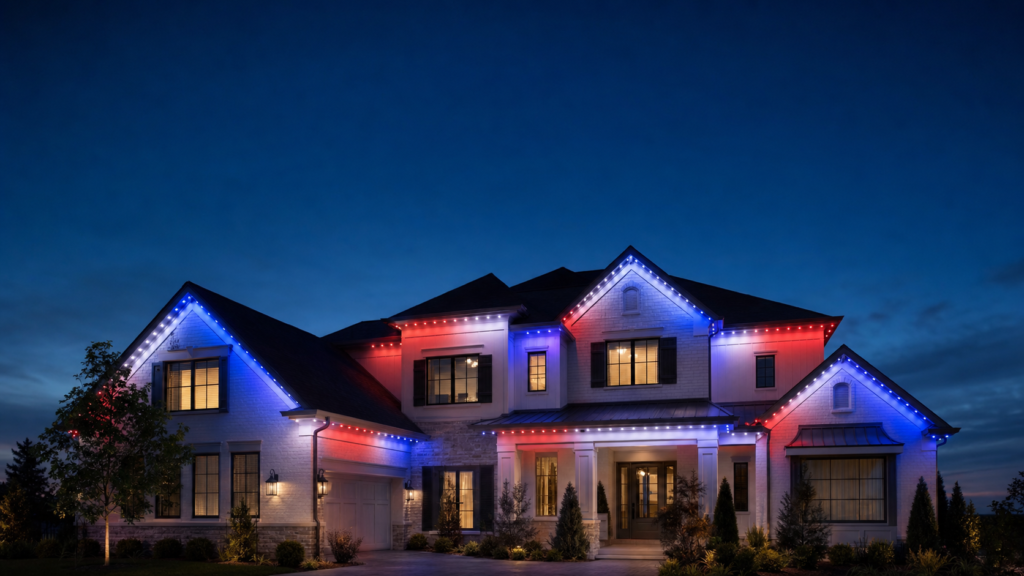
An RGBW system can also combine dedicated white with colored channels. This is useful for red-and-white, blue-and-white or green-and-white displays without relying on simulated RGB white.
Brightness and Energy Consumption
RGBW does not automatically mean brighter or more energy-efficient. Actual performance depends on the fixture design and operating mode.
Compare the following specifications:
- Rated wattage per light
- Luminous output
- Power consumption in white mode
- Power consumption with all channels active
- Maximum fixtures per power supply
- Voltage at the beginning and end of the run
- Recommended power-injection intervals
When an RGBW system operates only its dedicated white channel, it may provide efficient everyday illumination. However, activating multiple channels simultaneously can increase power demand.
Ask the manufacturer for model-specific electrical data instead of comparing systems only by the RGB or RGBW label.
Voltage, Wiring and Controller Compatibility
Permanent outdoor lighting systems may use 12V, 24V or 48V architectures. Higher-voltage systems can sometimes support longer runs with less voltage drop, but system performance also depends on cable gauge, fixture power and installation layout.
Do not assume the number of cable conductors identifies whether a product is RGB or RGBW. Addressable lighting systems may use integrated control chips and different wiring configurations.
Before ordering, confirm:
- Operating voltage
- Wire and connector type
- Supported controller
- Compatible IC or communication protocol
- Maximum lights per controller
- Maximum recommended run length
- Power-injection requirements
- Zone-control capability
- Firmware and app compatibility
Lights, controllers and power supplies should be tested as one complete system.
Performance in U.S. and Canadian Climates
Outdoor lighting in the United States and Canada may be exposed to snow, ice, rain, UV radiation, freeze-thaw cycles and coastal salt air.
Evaluate both RGB and RGBW products for:
- Model-specific IP rating
- Published operating temperature range
- UV-resistant cable and housing materials
- Waterproof connector design
- Corrosion-resistant mounting tracks
- Sealed cable entry points
- Thermal management
- Replaceable components
An IP65 rating indicates protection against dust and water jets under defined test conditions. It does not mean the fixture is suitable for continuous submersion, and it is not a substitute for electrical safety certification.
Safety and North American Compliance
Certification requirements depend on the fixture, controller, power supply, installation method and local jurisdiction.
For North American projects, ask for model-specific documentation related to:
- UL or ETL listing where applicable
- cUL or CSA certification for Canada where applicable
- FCC compliance for wireless controllers
- Power-supply certification
- Ingress-protection test reports
- Electrical and material compliance
Installers should also follow applicable National Electrical Code requirements in the United States, Canadian Electrical Code requirements in Canada and local authority requirements.
Never rely only on certification logos shown in marketing materials. Confirm that the documentation matches the exact model being purchased.
Which System Is Better for Your Project?
Choose RGB permanent outdoor lights when:
- Color effects are the primary purpose
- The system will mainly be used for holidays
- Natural warm-white lighting is not essential
- The project has a limited budget
- Decorative lighting is more important than architectural illumination
Choose RGBW permanent outdoor lights when:
- The lights will be used throughout the year
- Customers expect natural-looking white light
- The project includes architectural illumination
- The property needs everyday and holiday lighting
- The installation targets a premium residential or commercial market
For professional permanent outdoor lighting installations, RGBW usually offers broader application value because one system can support everyday warm-white lighting and dynamic seasonal effects.
What to Test Before Placing an Order
Request a working sample system and evaluate it under realistic conditions.
Test:
- Warm-white appearance on siding, brick or stone
- Color consistency between multiple fixtures
- Brightness and dimming performance
- App pairing and Wi-Fi reconnection
- Timers, schedules and zone controls
- Animation smoothness
- Controller response across a full test run
- Waterproof connectors and mounting hardware
- Voltage at the end of the lighting run
- Product labels, specifications and certification documents
Testing a complete sample kit is more reliable than evaluating a fixture from photographs or specifications alone.
GOULY RGBW Permanent Outdoor Lighting
GOULY develops permanent outdoor lighting systems for residential, commercial, dealer and professional installation projects.
Available system components include:
- RGB and RGBW permanent outdoor lights
- Smart lighting controllers
- Mobile app control
- Custom patterns and schedules
- Zone and group management
- Music and voice-control functions
- Aluminum mounting tracks
- Power supplies and installation accessories
Product specifications, supported controller models, color temperatures and compliance documents vary by model. Contact GOULY to confirm the correct configuration for your market and project.
Frequently Asked Questions
Can RGB permanent outdoor lights produce white?
Yes. RGB lights can simulate white by combining red, green and blue. The result may look cooler or less natural than light produced by a dedicated white emitter.
Is RGBW better for everyday lighting?
RGBW is generally better for everyday architectural lighting because it includes a dedicated white channel. Confirm the available color temperature before ordering.
Does RGBW consume more power than RGB?
Not necessarily. Energy consumption depends on fixture wattage, brightness and the channels being used. Compare model-specific electrical specifications.
Can an RGB controller operate RGBW lights?
Not always. The controller must support the fixture’s channel configuration, control protocol and IC type. Confirm compatibility with the manufacturer.
Is IP65 suitable for outdoor permanent lighting?
IP65 is commonly used for outdoor lighting exposed to dust and rain, but suitability depends on the installation location. Areas exposed to pooling water or submersion require a different protection level.
Should U.S. and Canadian buyers choose different products?
The lighting function may be the same, but certification, operating temperature and installation requirements can differ. Canadian projects should pay particular attention to cold-weather performance and applicable cUL or CSA documentation.
Request an RGB or RGBW Lighting Sample
Compare GOULY RGB and RGBW permanent outdoor lighting with a working sample system. Contact our team for specifications, controller compatibility and project recommendations.